
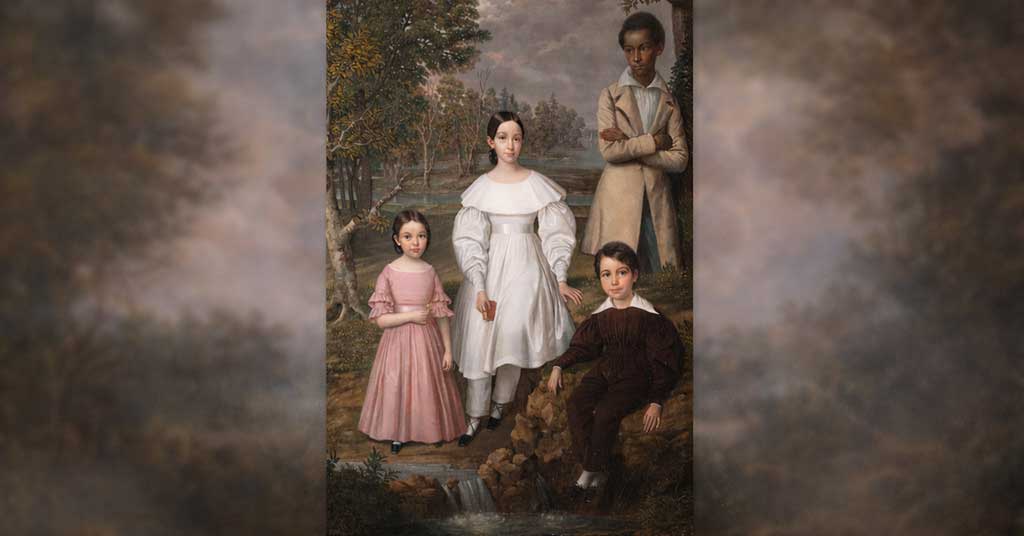
A young enslaved boy was painted out of a family portrait only to be restored decades later
Art restoration has always been a fascinating field of study, research and conservation. Painting conservators help preserve old artwork, repair damaged items, and remove layers of dust and dirt. It can also reveal images covered up by accident or on purpose.
That’s how a young slave, Bélizaire, disappeared and reappeared in a restored 19th-century painting. I discovered this story recently between shovelling sessions during Toronto’s snowiest day in history. It’s a fascinating tale of art, wealth, race and a covered-up image.
The French neoclassical painter Jacques Amans travelled by ship to New Orleans, Louisiana, in 1837. He was commissioned that year by German-born merchant/banker Frederick Frey to create a group portrait painting. Three of his children, Elizabeth, Léontine, and Frederick Jr., were at the forefront surrounded by scenes of nature. It’s a wonderful portrait that wealthy patrons like the Freys regularly displayed in their homes.
There was another person prominently depicted in the painting. He’s been identified as Bélizaire, an enslaved Afro-Creole teenager who took care of the Frey children.
Bélizaire was reportedly purchased by Frederick and his wife, Coralie, in 1828 when he was six years old. His mother, Sallie, was also acquired. Louisiana historian Katy Shannon told The Times-Picayune/The New Orleans Advocate’s Doug MacCash in Nov. 2021 that Bélizaire may have been mixed race. While no evidence exists that he’s “the product of a liaison between owner and enslaved people somewhere along the line,” the fact remains “it’s not impossible.”
Tragedy struck the Frey family not long after the painting was commissioned.
Elizabeth and Léontine both died in 1837, likely due to yellow fever. Frederick Jr. died several years later. An economic depression caused financial hardship for the family. The Freys were forced to sell Bélizaire in 1841 to pay off their debts.
They would buy him back, but Frederick died in 1851 and Coralie sold him again in 1857. Bélizaire was purchased by Lézin Becnel, “a prominent sugar planter in St. John the Baptist Parish,” according to the Ogden Museum of Southern Art, and was “brought to what is now Evergreen Plantation, where he laboured as a cook and domestic.” The last known record of Bélizaire’s whereabouts was in 1865, although the Metropolitan Museum of Art suggested he “survived the Civil War and lived to be free.”
Bélizaire didn’t just disappear from history. He disappeared from the group portrait as well.
It’s believed he was painted over around 1900 and replaced with additional landscape. How do we know this? A painting’s natural expansion and contraction, which often leads to cracks on the surface. “It would have taken 50 years or so to have this level of cracking,” painting conservator Craig Crawford told The New York Times in an Aug. 14, 2023, video. “The cover-up is visible within the craquelure patterns that would give me the impression that the cover-up happened around the turn of the century.”
It’s not hard to figure out why the young slave was removed. It likely occurred during the height of Jim Crow laws and racial segregation throughout the American South. Who did it? That’s unclear. It may always remain a mystery.
Audrey Grasser, a relative of the Frey family, inherited the painting and “for decades she kept it in the garage,” according to The New York Times. Her son, Eugene, recounted a family story that Bélizaire was a “favorite slave” who was included in the portrait and was later painted out. He had “no idea why.” Audrey eventually donated the painting to the New Orleans Museum of Art in 1972 and mentioned this old family story to them. Alas, the portrait was never displayed and was stored away for 32 years.
Why? John Bullard, the museum’s director from 1973 to 2010, told The New York Times that “when it came in, it was not in exhibitable condition.” He acknowledged “you could see the shadow” where Bélizaire had been painted over, “but still, it’s not attributed to a particular artist. And the children were not identified.” Bullard also mentioned “there are very few museums that can exhibit everything they own. One solution is to go through and decide what might be appropriately de-accessioned and sold.”
That’s what ultimately happened. An antiques dealer bought the painting for $6,000 in 2004 and had it restored. Bélizaire’s image was returned to prominence once more. Bullard was asked about the museum’s misguided role in this sequence of events. His response? “I think, in hindsight, it was a mistake. Yes, but mistakes happen.”
Jeremy K. Simien, a Louisiana-based art collector and historian, was the last piece of the puzzle. He came across the restored painting by chance in an auction record. It was unsigned, but he thought it looked similar to Amans’s work. He found an older auction record of the painting, then called “Portrait of three children in a Louisiana landscape,” in which Bélizaire was still covered up. “The fact that the boy was covered up, it haunted me. I had to find out where he ended up.”
Simien bought the painting in 2021 and brought it home. With Shannon’s help, he confirmed the young slave’s name and personal history. “My ancestors, people of African descent, are part of this United States,” he told The New York Times. “And we have got to be able to see ourselves in a historical context.”
That’s certainly the case today.
The painting now has a proper title, “Bélizaire and the Frey Children.” It was purchased by the Metropolitan Museum of Art in 2023. Sylvia Yount, the Lawrence A. Fleischman curator in charge of the American Wing where Amans’s portrait is on permanent display, said, “the acquisition of this rare painting is transformative for the American Wing, representing our first naturalistic portrait of a named Black subject set in a southern landscape.”
Bélizaire’s image disappeared in a group portrait, reappeared after the paint was removed and became an attraction in a world-renowned museum. It’s doubtful the young slave would have ever believed his life story could have been restored in such a fashion.
Michael Taube is a political commentator, Troy Media syndicated columnist and former speechwriter for Prime Minister Stephen Harper. He holds a master’s degree in comparative politics from the London School of Economics, lending academic rigour to his political insights.
Explore more on Painting, History, Culture, Arts, Slavery
The views, opinions, and positions expressed by our columnists and contributors are solely their own and do not necessarily reflect those of our publication.
Troy Media empowers Canadian community news outlets by providing independent, insightful analysis and commentary. Our mission is to support local media in helping Canadians stay informed and engaged by delivering reliable content that strengthens community connections and deepens understanding across the country.

