
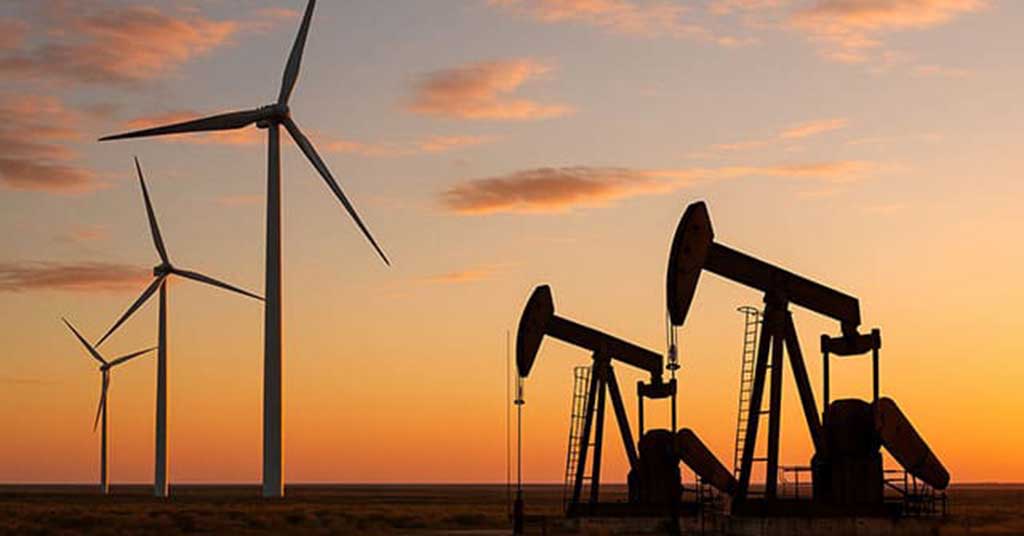
A system meant to cut emissions now steers money away from wind and solar and toward oil and gas
Key points
- Money collected to cut industrial emissions is no longer being used the way it was promised.
- That shift has left wind and solar projects without funding, even though the program was meant to support them.
- When renewable projects stall, communities lose construction jobs, local investment, and new sources of tax revenue.
- With fewer alternate energy options being built, Alberta risks higher costs and less flexibility as electricity demand grows.
What’s this?

The Alberta government has turned a carbon-pricing program designed to cut emissions into what amounts to a subsidy for oil and gas.
Money that once helped build Alberta’s wind and solar sector has been effectively cut off.
It all starts with a provincial carbon pricing program called the Technology Innovation and Emissions Reduction program (TIER), introduced in January 2020 as a replacement for the Carbon Competitiveness Incentive Regulation. Alberta was the first jurisdiction in Canada to implement carbon pricing, doing so in 2007 under the Progressive Conservative government of Ed Stelmach. TIER applies to large industrial emitters, not households or small businesses covered by the federal consumer carbon tax.
Over the years, Alberta’s carbon pricing programs invested an estimated $6 billion in projects intended to reduce emissions or replace fossil fuels with renewable sources. TIER was meant to continue that work.
The regulation targets facilities emitting 100,000 tonnes or more of CO2e (carbon dioxide equivalent) per year. Large emitters must either reduce carbon intensity or pay into the TIER Fund, meant to support technological innovation, renewable energy, and carbon capture and storage.
Instead, funding has flowed predominantly to oil and gas. Reports from the Emissions Reduction Alberta (ERA) website show 212 oil and gas conventional and oil sands projects receiving support, drawing $616 million from the fund. Wind and solar projects received roughly $126 million.
“It is clear that for the last couple of years money is going to [oil and gas] business support,” said one wind farm project manager I spoke with. “There’s not really any wind/solar projects since 2021.”
Data from the ERA website also show that of 380 projects funded since 2010, just 22 were classified as renewables, with two-thirds funded in the 2010s. Even that figure overstates support, as ERA’s definition of “renewables” includes projects such as community diesel reductions.
Since 2019, about $1.6 billion from the TIER fund has gone to oil and gas projects, including hydrogen and methane reduction initiatives that, in practice, support continued fossil fuel production rather than replacement.
The industrial carbon price was supposed to rise to $170 per tonne CO2e by 2030. Instead, it was frozen at $95 per tonne CO2e in May 2025. The government said the freeze would provide short-term relief while preserving competitiveness. Months later, Premier Danielle Smith and Environment Minister Rebecca Schulz announced a full overhaul of TIER, accelerating the shift away from genuine emissions reduction.
The Canadian Renewable Energy Association (CanREA) raised alarms. Under the new rules, emitters can receive credits for technical and financial studies “that do not result in actual emissions reductions,” or be credited for planning a project and again for implementation under the revised rules. In carbon-pricing systems, credits reduce or eliminate a facility’s compliance costs, meaning weak or unverified credits undermine the incentive to actually cut emissions.
CanREA also warned that allowable investments could include “routine refurbishments or optimizations that do not represent genuine emissions abatement,” effectively allowing business as usual to qualify as climate action.
This represents a sharp break from a program that evolved over six premiers—Ed Stelmach, Alison Redford, Dave Hancock, Jim Prentice, Rachel Notley and Jason Kenney—across Progressive Conservative, NDP and United Conservative Party (UCP) governments. Jason Kenney, the UCP’s first premier, actually strengthened the industrial carbon price.
For years, credits were issued only for activities that “demonstrably reduce emissions, on a strict, tonne-for-tonne basis,” according to CanREA. That discipline delivered real results.
“For 15 years, it was an absolute success story. It brought in billions of dollars in investment,” said Al-Guneid. In 2023, Alberta had 92 per cent of all renewable projects in Canada. Today, 99 per cent of those projects have collapsed. “It’s extremely unfortunate,” she said.
Al-Guneid said the only motive she can even imagine is the government’s ideological approach to the renewable energy moratorium.
“I’m at a loss as to why they’re doing it,” she said. “Why can’t we be leaders in all sorts of energy technology?”
Worse, the government rolled out its changes with minimal consultation, unlike in previous updates to the project. Radha Rajagopalan, CanREA’s Director of Policy for Alberta, said the hurried process “risks the reputation of a program built on nearly two decades of collaborative regulatory and policy development.”
“Alberta’s TIER system had long been a beacon of stability for attracting investment in clean energy and clean technology. The speed and scale of these changes is both surprising and troublesome,” she added.
The lingering question is why this UCP government is so dead-set on destroying a cross-partisan Alberta success story.
Why indeed. When this government is finally relegated to the slag heap of history, the cost of these choices will be tallied. From dismantling health care to undermining public education, from opening the Eastern Slopes to coal to gutting a once-thriving renewables industry, the financial damage will run into the billions.
The social cost will be higher still.
Doug Firby is an award-winning editorial writer with over four decades of experience working for newspapers, magazines and online publications in Ontario and western Canada. Previously, he served as Editorial Page Editor at the Calgary Herald.
Explore more on Energy sector, Clean technology, GHG emissions
The views, opinions, and positions expressed by our columnists and contributors are solely their own and do not necessarily reflect those of our publication.
Troy Media empowers Canadian community news outlets by providing independent, insightful analysis and commentary. Our mission is to support local media in helping Canadians stay informed and engaged by delivering reliable content that strengthens community connections and deepens understanding across the country.

