
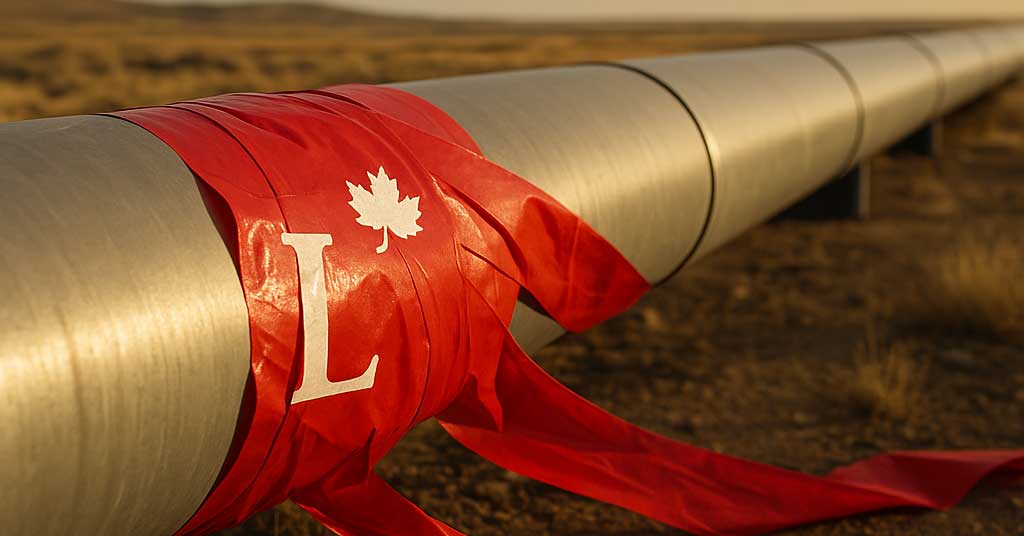
The Alberta pipeline deal promises jobs, exports and growth, but Ottawa’s climate policies and endless delays still threaten to kill it
Prime Minister Mark Carney says he wants pipelines, but his own policies still punish the industry building them.
That contradiction sits at the heart of the May 15, 2026, Memorandum of Understanding (MOU) between Ottawa and Alberta for a new crude oil pipeline to Canada’s West Coast. The agreement promises faster approvals, access to Asian markets and billions in potential economic growth. But it also keeps many of the climate policies and costs that helped cripple previous energy projects.
Ottawa and Alberta are now locked into an extremely aggressive approval timeline after a decade of stalled, delayed and cancelled energy projects. The Carney government says the pipeline will be declared in the national interest by Oct. 1, 2026, with construction approval expected by Sept. 1, 2027.
At the same time, Ottawa says it wants to simplify the regulatory process by backing away from the much-criticized Impact Assessment Act of 2019, which many industry critics blamed for years of uncertainty and delays.
That should reassure investors. But they’ve heard promises like this before.
“The MOU Implementation Agreement is a meaningful step toward restoring confidence in Canadian energy infrastructure,” says Michael Binnion, president of Questerre Energy Corporation. “However, the underlying economics deserve a clearer hearing.”
He is right.
The biggest problem is Ottawa’s decision to tie the pipeline directly to the massive Pathways CCUS project. The federal government and Alberta reaffirmed that construction of the pipeline and the multibillion-dollar carbon capture system are mutually dependent. That linkage may ultimately threaten the entire deal.
Ottawa and Alberta are forcing oilsands producers to absorb the regulatory burdens of this massive CCUS project even though international competitors face no such rules.
The broader carbon-cost problem does not stop there.
The agreement also raises the carbon price from $95 per tonne in 2026 to $130 per tonne in 2035, with further increases afterward. Although that trajectory is lower than Ottawa’s earlier proposal, it still threatens Canadian competitiveness. At $130 per tonne, Canadian producers could face compliance costs ranging from 50 cents to as much as $2 per barrel while competitors in other countries avoid similar burdens.
Instead of reducing costs and uncertainty to attract investment, governments are layering new climate obligations onto the very industry expected to finance and build the project.
Governments are also relying on taxpayer-funded incentives to cover much of the estimated $20-billion capital cost of Pathways CCUS along with billions more in operating costs. That comes as Canadians are already struggling with affordability pressures, high taxes and growing federal debt.
Ottawa is also quietly acknowledging another reality it spent years resisting: Canada still needs enormous amounts of reliable energy.
The agreement calls for expanded electricity infrastructure, continued natural gas generation and major transmission-line construction. Those commitments directly contradict years of political messaging suggesting Canada could rapidly move away from fossil fuels without major economic consequences.
Natural gas will continue playing a major role in Canada’s electricity system because governments are finally confronting the realities of electrification, industrial demand and AI data centres.
But even if the economics somehow work, major political and legal risks still remain.
A private-sector proponent capable of financing and building the pipeline has yet to emerge. Potential investors have watched previous pipeline projects collapse after years of political fights, court battles and regulatory delays.
British Columbia remains openly hostile to new pipelines. Indigenous consultations could also trigger prolonged legal disputes despite support from many Indigenous communities.
Canadians have seen this movie before.
Opposition and political uncertainty already delayed and dramatically increased the cost of the federally owned Trans Mountain Expansion pipeline.
Carney now says Canada wants pipelines again. But if Ottawa continues piling climate costs, regulatory uncertainty and political risk onto the industry expected to build them, investors may conclude nothing has really changed.
The opportunity before Canada is real. So is the possibility that Ottawa will once again smother a major energy project under the weight of its own climate policies.
Yogi Schulz is an energy sector specialist and technology executive with 40 years of experience in Western Canada. A former board member of the Professional Petroleum Data Management (PPDM) Association, he advises on project risk, technological readiness, and regulatory compliance frameworks for major resource developments. He is the co-author of A Project Sponsor’s Warp-Speed Guide.
Explore more on Pipelines, Energy sector, Carbon capture, Carbon tax
The views, opinions, and positions expressed by our columnists and contributors are solely their own and do not necessarily reflect those of our publication.
Troy Media empowers Canadian community news outlets by providing independent, insightful analysis and commentary. Our mission is to support local media in helping Canadians stay informed and engaged by delivering reliable content that strengthens community connections and deepens understanding across the country.

